Overview
Alzheimer's disease is a brain disorder that gets worse over time. It's characterized by changes in the brain that lead to deposits of certain proteins. Alzheimer's disease causes the brain to shrink and brain cells to eventually die. Alzheimer's disease is the most common cause of dementia — a gradual decline in memory, thinking, behavior and social skills. These changes affect a person's ability to function.
About 6.5 million people in the United States age 65 and older live with Alzheimer's disease. Among them, more than 70% are 75 years old and older. Of the about 55 million people worldwide with dementia, 60% to 70% are estimated to have Alzheimer's disease.
The early signs of the disease include forgetting recent events or conversations. Over time, it progresses to serious memory problems and loss of the ability to perform everyday tasks.
Medicines may improve or slow the progression of symptoms. Programs and services can help support people with the disease and their caregivers.
There is no treatment that cures Alzheimer's disease. In advanced stages, severe loss of brain function can cause dehydration, malnutrition or infection. These complications can result in death.
Products & Services
Symptoms
Memory loss is the key symptom of Alzheimer's disease. Early signs include difficulty remembering recent events or conversations. But memory gets worse and other symptoms develop as the disease progresses.
At first, someone with the disease may be aware of having trouble remembering things and thinking clearly. As symptoms get worse, a family member or friend may be more likely to notice the issues.
Brain changes associated with Alzheimer's disease lead to growing trouble with:
Memory
Everyone has memory lapses at times, but the memory loss associated with Alzheimer's disease persists and gets worse. Over time, memory loss affects the ability to function at work or at home.
People with Alzheimer's disease may:
- Repeat statements and questions over and over.
- Forget conversations, appointments or events.
- Misplace items, often putting them in places that don't make sense.
- Get lost in places they used to know well.
- Eventually forget the names of family members and everyday objects.
- Have trouble finding the right words for objects, expressing thoughts or taking part in conversations.
Thinking and reasoning
Alzheimer's disease causes difficulty concentrating and thinking, especially about abstract concepts such as numbers.
Doing more than one task at once is especially difficult. It may be challenging to manage finances, balance checkbooks and pay bills on time. Eventually, a person with Alzheimer's disease may be unable to recognize and deal with numbers.
Making judgments and decisions
Alzheimer's disease causes a decline in the ability to make sensible decisions and judgments in everyday situations. For example, a person may make poor choices in social settings or wear clothes for the wrong type of weather. It may become harder for someone to respond to everyday problems. For example, the person may not know how to handle food burning on the stove or decisions when driving.
Planning and performing familiar tasks
Routine activities that require completing steps in order become a struggle. This may include planning and cooking a meal or playing a favorite game. Eventually, people with advanced Alzheimer's disease forget how to do basic tasks such as dressing and bathing.
Changes in personality and behavior
Brain changes that occur in Alzheimer's disease can affect moods and behaviors. Problems may include the following:
- Depression.
- Loss of interest in activities.
- Social withdrawal.
- Mood swings.
- Distrust in others.
- Anger or aggression.
- Changes in sleeping habits.
- Wandering.
- Loss of inhibitions.
- Delusions, such as believing something has been stolen.
Preserved skills
Despite major changes to memory and skills, people with Alzheimer's disease are able to hold on to some skills even as symptoms get worse. Preserved skills may include reading or listening to books, telling stories, sharing memories, singing, listening to music, dancing, drawing, or doing crafts.
These skills may be preserved longer because they're controlled by parts of the brain affected later in the course of the disease.
When to see a doctor
A number of conditions can result in memory loss or other dementia symptoms. Some of those conditions can be treated. If you are concerned about your memory or other thinking skills, talk to your health care professional.
If you are concerned about thinking skills you observe in a family member or friend, talk about your concerns and ask about going together to talk to a health care professional.
More Information
Causes
Healthy brain and brain with Alzheimer's disease
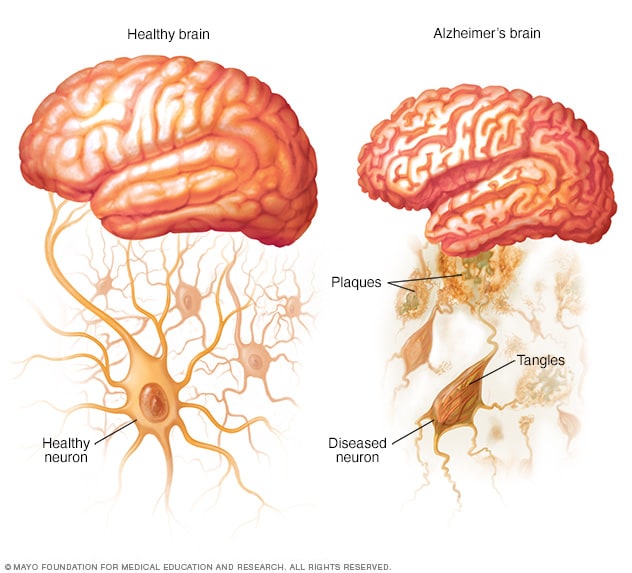
Healthy brain and brain with Alzheimer's disease
In the brain of someone with Alzheimer's disease, amyloid plaques form and tau proteins change shape and become tangles.
The exact causes of Alzheimer's disease aren't fully understood. But at a basic level, brain proteins fail to function as usual. This disrupts the work of brain cells, also called neurons, and triggers a series of events. The neurons become damaged and lose connections to each other. They eventually die.
Scientists believe that for most people, Alzheimer's disease is caused by a combination of genetic, lifestyle and environmental factors that affect the brain over time. In less than 1% of cases, Alzheimer's is caused by specific genetic changes that almost guarantee a person will develop the disease. In these cases, the disease usually begins in middle age.
The development of the disease begins years before the first symptoms. The damage most often starts in the region of the brain that controls memory. The loss of neurons spreads in a somewhat predictable pattern to other regions of the brain. By the late stage of the disease, the brain has shrunk significantly.
Researchers trying to understand the cause of Alzheimer's disease are focused on the role of two proteins:
- Plaques. Beta-amyloid is a fragment of a larger protein. When these fragments clump together, they appear to have a toxic effect on neurons and to disrupt communication between brain cells. These clumps form larger deposits called amyloid plaques, which also include other cellular debris.
- Tangles. Tau proteins play a part in a brain cell's internal support and transport system to carry nutrients and other essential materials. In Alzheimer's disease, tau proteins change shape and organize into structures called neurofibrillary tangles. The tangles disrupt the transport system and cause damage to cells.
Risk factors
Age
Increasing age is the greatest known risk factor for Alzheimer's disease. Alzheimer's isn't a part of typical aging. But as you grow older, the chances of developing it increases.
One study found that every year there were four new diagnoses per 1,000 people ages 65 to 74. Among people ages 75 to 84, there were 32 new diagnoses per 1,000 people. For those 85 and older, there were 76 new diagnoses per 1,000 people.
Family history and genetics
The risk of developing Alzheimer's is somewhat higher if a first-degree relative — your parent or sibling — has the disease. Just how genes among families affect the risk is largely unexplained, and the genetic factors are likely complex.
A better understood genetic factor is a form of the apolipoprotein E (APOE) gene. A form of the gene, APOE e4, increases the risk of Alzheimer's disease. About 25% to 30% of the population carries APOE e4. But not everyone with this form of the gene develops the disease.
Scientists have found rare changes in three genes that virtually guarantee a person who inherits one of them will develop Alzheimer's. But these changes account for less than 1% of people with Alzheimer's disease.
Down syndrome
Many people with Down syndrome develop Alzheimer's disease. This is likely related to having three copies of chromosome 21. Chromosome 21 is the gene involved in the production of the protein that leads to the creation of beta-amyloid. Beta-amyloid fragments can become plaques in the brain. Symptoms tend to appear 10 to 20 years earlier in people with Down syndrome than they do for the general population.
Sex
Overall there are more women with the disease because they tend to live longer than men.
Mild cognitive impairment
Someone with mild cognitive impairment (MCI) has a decline in memory or other thinking skills that is greater than usual for the person's age. But the decline doesn't prevent the person from functioning in social or work environments.
However, people with MCI have a significant risk of developing dementia. When MCI affects mainly memory, the condition is more likely to progress to dementia due to Alzheimer's disease. A diagnosis of MCI offers people the chance to put a greater focus on healthy lifestyle changes and to come up with strategies to make up for memory loss. They also can schedule regular health care appointments to monitor symptoms.
Head trauma
Several large studies found that people age 50 years or older who had a traumatic brain injury (TBI) had an increased risk of dementia and Alzheimer's disease. The risk is even higher in people with more-severe and multiple TBIs. Some studies found that the risk may be greatest within the first six months to two years after the injury.
Air pollution
Studies in animals have found that air pollution particulates can speed the breakdown of the nervous system. And human studies have found that air pollution exposure — especially from traffic exhaust and burning wood — is linked to a greater dementia risk.
Excessive alcohol consumption
Drinking large amounts of alcohol has long been known to cause brain changes. Several large studies and reviews found that alcohol use disorders were linked to an increased risk of dementia — early-onset dementia in particular.
Poor sleep patterns
Research has shown that poor sleep patterns, such as trouble falling asleep or staying asleep, are linked to an increased risk of Alzheimer's disease.
Lifestyle and heart health
Research has shown that the same risk factors associated with heart disease also may increase the risk of dementia. It's unclear if these factors increase risk of dementia by worsening Alzheimer's changes in the brain or by leading to brain vascular changes. They include:
- Lack of exercise.
- Obesity.
- Smoking or exposure to secondhand smoke.
- High blood pressure.
- High cholesterol.
- Poorly controlled type 2 diabetes.
These factors can all be modified. Therefore, changing lifestyle habits can to some degree alter your risk. For example, regular exercise and a healthy low-fat diet rich in fruits and vegetables are related to a lower risk of Alzheimer's disease.
Lifelong learning and social engagement
Studies have found that socializing and engaging in activities that stimulate the mind throughout life can lower the risk of Alzheimer's disease. Low education levels — less than a high school education — appear to be a risk factor for Alzheimer's disease.
Complications
Alzheimer's symptoms such as memory loss, language loss, impaired judgment and other brain changes can make it harder to manage other health conditions. A person with Alzheimer's disease may not be able to:
- Tell someone about being in pain.
- Explain symptoms of another illness.
- Follow a treatment plan.
- Explain medicine side effects.
As Alzheimer's disease moves into its last stages, brain changes begin to affect physical functions. The changes can affect the ability to swallow, balance, and control bowel and bladder movements. These effects can lead to other health problems such as:
- Inhaling food or liquid into the lungs.
- Flu, pneumonia and other infections.
- Falls.
- Fractures.
- Bedsores.
- Poor nutrition or dehydration.
- Constipation or diarrhea.
- Dental problems such as mouth sores or tooth decay.
Prevention
Alzheimer's disease is not a preventable condition. However, a number of lifestyle risk factors can be modified.
Evidence suggests that taking steps to reduce the risk of cardiovascular disease may also lower your risk of developing dementia.
To follow heart-healthy lifestyle choices that may reduce the risk of dementia:
- Exercise regularly.
- Eat a diet of fresh produce, healthy oils and foods low in saturated fat, such as a Mediterranean diet.
- Follow treatment guidelines to manage high blood pressure, diabetes and high cholesterol.
- If you smoke, ask your health care professional for help to quit.
One large, long-term study done in Finland found that making lifestyle changes helped reduce cognitive decline among people who were at risk of dementia. Those in the study were given individual and group sessions that focused on diet, exercise and social activities.
In another study done in Australia, people at risk of dementia were given coaching sessions on diet, exercise and other lifestyle changes. They had better results on cognitive tests after one, two and three years compared to people who didn't receive the coaching.
Other studies have shown that staying engaged mentally and socially is linked to preserved thinking skills later in life and a lower risk of Alzheimer's disease. This includes going to social events, reading, dancing, playing board games, creating art, playing an instrument and other activities.
Feb. 13, 2024