Fetal development: The 2nd trimester
Fetal development takes on new meaning in the second trimester. Highlights might include finding out your baby's sex and feeling your baby move.
By Mayo Clinic Staff
As your pregnancy progresses, your baby might begin to seem more real. Two months ago, your baby was a cluster of cells. Now he or she has functioning organs, nerves and muscles. Find out what happens during the second trimester by checking out this weekly calendar of events. Keep in mind that measurements are approximate.
Week 13: Urine forms
Thirteen weeks into your pregnancy, or 11 weeks after conception, your baby is beginning to make urine and release it into the surrounding amniotic fluid. Your baby also swallows some amniotic fluid.
Bones are beginning to harden in your baby's skeleton, especially in the skull and long bones. Your baby's skin is still thin and transparent, but it will start to thicken soon.
Week 14: Baby's sex becoming apparent
Fourteen weeks into your pregnancy, or 12 weeks after conception, your baby's neck has become more defined. Red blood cells are forming in your baby's spleen.
Your baby's sex will become apparent this week or in the coming weeks.
By now your baby might be almost 3 1/2 inches (87 millimeters) long from crown to rump and weigh about 1 1/2 ounces (45 grams).
Week 15: Baby's scalp pattern develops
Fifteen weeks into your pregnancy, or 13 weeks after conception, your baby is growing rapidly. Bone development continues and will soon become visible on ultrasound images. Your baby's scalp hair pattern also is forming.
Week 16: Baby's eyes move
Fetal development 14 weeks after conception
Fetal development 14 weeks after conception
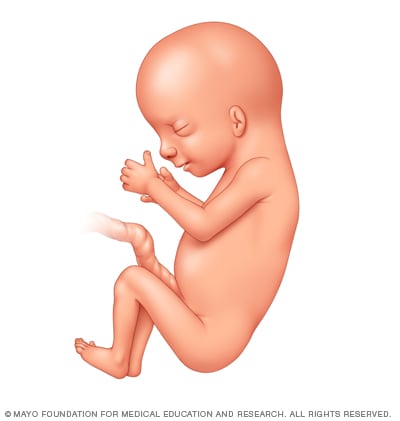
Fetal development 14 weeks after conception
By the end of the 16th week of pregnancy — 14 weeks after conception — your baby's limb movements are becoming more coordinated.
Sixteen weeks into your pregnancy, or 14 weeks after conception, your baby's head is erect. His or her eyes can slowly move. The ears are close to reaching their final position. Your baby's skin is getting thicker.
Your baby's limb movements are becoming coordinated and can be detected during ultrasound exams. However, these movements are still too slight to be felt by you.
By now your baby might be more than 4 1/2 inches (120 millimeters) long from crown to rump and weigh close to 4 ounces (110 grams).
Week 17: Baby's toenails develop
Seventeen weeks into your pregnancy, or 15 weeks after conception, toenails begin developing.
Your baby is becoming more active in the amniotic sac, rolling and flipping. His or her heart is pumping about 100 pints of blood each day.
Week 18: Baby begins to hear
Eighteen weeks into your pregnancy, or 16 weeks after conception, your baby's ears begin to stand out on the sides of his or her head. Your baby might begin to hear sounds. The eyes are beginning to face forward. Your baby's digestive system has started working.
By now your baby might be 5 1/2 inches (140 millimeters) long from crown to rump and weigh 7 ounces (200 grams).
Week 19: Baby develops protective coating
Nineteen weeks into your pregnancy, or 17 weeks after conception, growth slows.
A greasy, cheeselike coating called vernix caseosa begins to cover your baby. The vernix caseosa helps protect your baby's delicate skin from abrasions, chapping and hardening that can result from exposure to amniotic fluid.
For girls, the uterus and vaginal canal are forming.
Week 20: The halfway point
Halfway into your pregnancy, or 18 weeks after conception, you might be able to feel your baby's movements (quickening). Your baby is regularly sleeping and waking. He or she might be awakened by noises or your movements.
By now your baby might be about 6 1/3 inches (160 millimeters) long from crown to rump and weigh more than 11 ounces (320 grams).
Week 21: Baby can suck his or her thumb
Fetal development 19 weeks after conception
Fetal development 19 weeks after conception
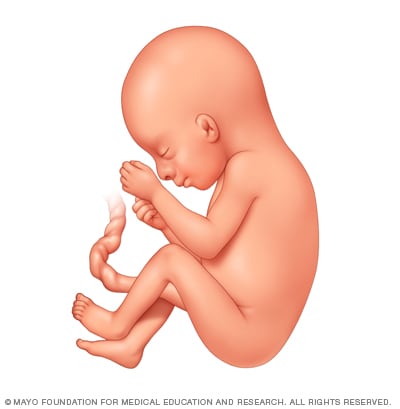
Fetal development 19 weeks after conception
By the end of the 21st week of pregnancy — 19 weeks after conception — your baby might suck his or her thumb.
Twenty-one weeks into your pregnancy, or 19 weeks after conception, your baby is completely covered with a fine, downy hair called lanugo. The lanugo helps hold the vernix caseosa on the skin.
The sucking reflex also is developing, enabling your baby to suck his or her thumb.
Week 22: Baby's hair becomes visible
Twenty-two weeks into your pregnancy, or 20 weeks after conception, your baby's eyebrows and hair are visible. Brown fat also is forming, the site of heat production.
For boys, the testes have begun to descend.
By now your baby might be 7 1/2 inches (190 millimeters) long from crown to rump and weigh about 1 pound (460 grams).
Week 23: Fingerprints and footprints form
Twenty-three weeks into your pregnancy, or 21 weeks after conception, your baby begins to have rapid eye movements. Ridges also form in the palms of the hands and soles of the feet that will later create the foundation for fingerprints and footprints.
Your baby might begin hiccuping, causing jerking movements.
Week 24: Baby's skin is wrinkled
Twenty-four weeks into your pregnancy, or 22 weeks after conception, your baby's skin is wrinkled, translucent and pink to red because of visible blood in the capillaries.
By now your baby might be about 8 inches (210 millimeters) long from crown to rump and weigh more than 1 1/3 pounds (630 grams).
Week 25: Baby responds to your voice
Fetal development 23 weeks after conception
Fetal development 23 weeks after conception
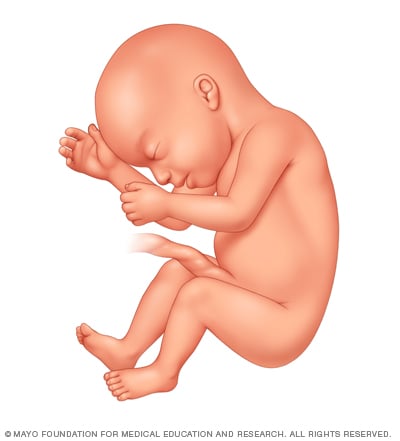
Fetal development 23 weeks after conception
By the end of the 25th week of pregnancy — 23 weeks after conception — your baby might be able to respond to your voice with movement.
Twenty-five weeks into your pregnancy, or 23 weeks after conception, your baby might be able to respond to familiar sounds, such as your voice, with movement.
Your baby is spending most of his or her sleep time in rapid eye movement (REM), when the eyes move rapidly even though the eyelids are closed.
Week 26: Baby's lungs develop
Twenty-six weeks into your pregnancy, or 24 weeks after conception, your baby's lungs are beginning to produce surfactant, the substance that allows the air sacs in the lungs to inflate — and keeps them from collapsing and sticking together when they deflate.
By now your baby might be 9 inches (230 millimeters) long from crown to rump and weigh nearly 2 pounds (820 grams).
Week 27: 2nd trimester ends
This week marks the end of the second trimester. At 27 weeks, or 25 weeks after conception, your baby's nervous system is continuing to mature. Your baby is also gaining fat, which will help his or her skin look smoother.
June 03, 2022
- American College of Obstetricians and Gynecologists. Your Pregnancy and Childbirth Month to Month. 6th ed. American College of Obstetricians and Gynecologists; 2015.
- Moore KL, et al. The Developing Human: Clinically Oriented Embryology. 11th ed. Elsevier; 2020. https://www.clinicalkey.com. Accessed Feb. 25, 2020.
- Frequently asked questions: Pregnancy FAQ156: Prenatal development: How your baby grows during pregnancy. American College of Obstetricians and Gynecologists. http://www.acog.org/Patients/FAQs/Prenatal-Development-How-Your-Baby-Grows-During-Pregnancy. Accessed June 6, 2017.
- Pregnancy: Stages of pregnancy. Office on Women's Health. . https://www.womenshealth.gov/pregnancy/youre-pregnant-now-what/stages-pregnancy. Accessed Feb. 25, 2020.