Overview
A hydrocele (HI-droe-seel) is a type of swelling in the scrotum, the pouch of skin that holds the testicles. This swelling happens when fluid collects in the thin sac that surrounds a testicle. Hydroceles are common in newborns. They often go away without treatment by age 1. Older children and adults can get a hydrocele due to an injury within the scrotum or other health problems.
A hydrocele often isn't painful or harmful. It might not need any treatment. But it's important to see a health care provider if the scrotum looks swollen.
Products & Services
Symptoms
Often the only sign of a hydrocele is a painless swelling of one or both testicles.
The swelling might make an adult's scrotum feel heavy. In general, pain gets worse as the swelling increases. Sometimes, the swollen area might be smaller in the morning and larger later in the day.
When to see a doctor
See your health care provider if you or your child has swelling of the scrotum. It's important to find out if there are other causes of the swelling that could be treated. For example, a hydrocele might be linked with a weak point in the ab muscles that allows part of the intestine to extend into the scrotum. This problem is called inguinal hernia.
A baby's hydrocele often goes away on its own. But if your baby still has a hydrocele after a year or if the swelling gets worse, ask your child's health care provider to check the hydrocele again.
Get help right away if you or your child has sudden, terrible pain or swelling in the scrotum. It's extra important to get prompt treatment if the pain or swelling starts within a few hours of an injury to the scrotum. These symptoms can happen with certain health problems, including blocked blood flow in a twisted testicle. This problem is called testicular torsion. It needs to be treated within hours of the symptoms starting to save the testicle.
Causes
Babies
Hydrocele
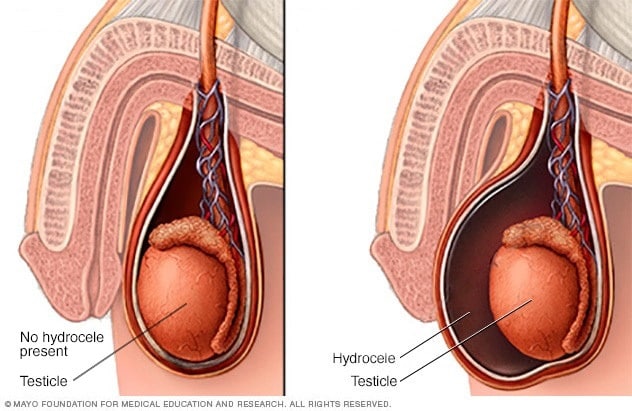
Hydrocele
Hydrocele is the type of scrotal swelling that occurs when fluid collects in the thin sheath that surrounds the testicle.
A hydrocele can form before birth. Typically, the testicles descend from the developing baby's stomach area into the scrotum. A sac comes with each testicle, letting fluid surround the testicles. Most often, each sac closes and the fluid is absorbed.
Sometimes, the fluid stays after the sac closes. This is called a noncommunicating hydrocele. The fluid usually is absorbed by age 1 or 2. Other times, the sac stays open. This is called a communicating hydrocele. The sac can change size, or fluid can flow back into the stomach area. Communicating hydroceles are often linked with inguinal hernia.
Older people
A hydrocele can form due to an injury. Or it can form because of a type of swelling, called inflammation, within the scrotum. Inflammation might be caused by an infection in the testicle or in the small, coiled tube at the back of each testicle.
Risk factors
Most hydroceles are present at birth. At least 5% of newborn males have a hydrocele. Premature babies, who are born more than three weeks before their due dates, have a higher risk of having a hydrocele.
Risk factors for getting a hydrocele later in life include:
- Injury or inflammation within the scrotum.
- Infection, including a sexually transmitted infection.
Complications
A hydrocele often isn't dangerous and usually doesn't affect the ability to have a baby. But a hydrocele might be linked with a health problem that can cause serious issues. These problems include:
- Infection or tumor. Either might cause the testicles to make less sperm or not work as well as usual.
- Inguinal hernia. This can lead to life-threatening health problems.
Jan. 12, 2023