Kegel exercises: A how-to guide for women
Kegel exercises can help prevent or control urinary leaking and other pelvic floor symptoms. Here's a step-by-step guide to doing Kegel exercises correctly.
By Mayo Clinic Staff
Kegel exercises strengthen the pelvic floor muscles. These muscles support the uterus, bladder, small intestine and rectum. Kegel exercises also are known as pelvic floor muscle training.
With practice, you can do Kegels just about anytime. But before you start doing these exercises, learn how to find the correct muscles and understand the proper technique.
Why Kegel exercises matter
Female pelvic floor muscles
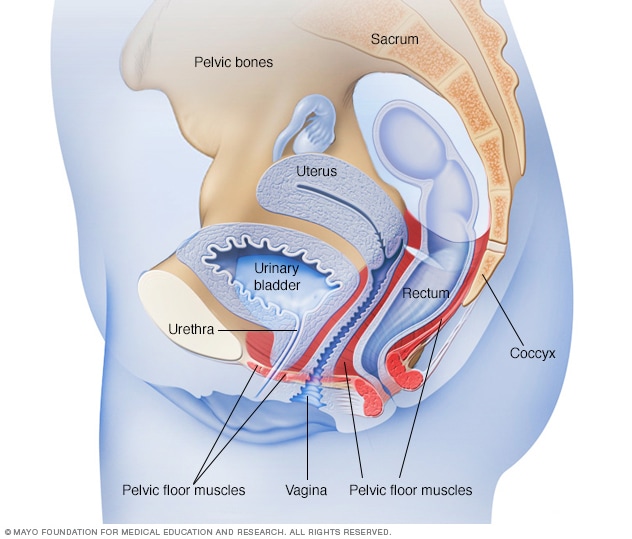
Female pelvic floor muscles
The pelvic floor muscles support the pelvic organs. Those organs include the uterus, bladder and rectum. Kegel exercises can help strengthen the pelvic floor muscles.
Many factors can weaken your pelvic floor muscles, including:
- Pregnancy.
- Childbirth.
- Surgery.
- Aging.
- Too much straining from constipation or lots of coughing.
- Being overweight.
You might benefit from doing Kegel exercises if you:
- Leak a few drops of urine while sneezing, laughing or coughing. This is known as stress incontinence.
- Leak urine after having a strong, sudden urge to urinate. This is called urge incontinence.
- Leak stool, also known as fecal incontinence.
Kegels are less helpful for people who leak lots of urine when they sneeze, cough or laugh. Also, Kegel exercises are less helpful for people who suddenly leak small amounts of urine due to a full bladder. This is called overflow incontinence.
Kegel exercises also can be done during pregnancy or after childbirth to help ease or prevent incontinence symptoms.
Before you start doing Kegels, ask your healthcare professional if these exercises are right for you.
How to do Kegel exercises
To get started:
- Find the right muscles. There are a few ways to find your pelvic floor muscles. Squeeze the muscles you use to stop passing gas. Or squeeze the muscles you use to stop urination in midstream. You should notice a slight pulling feeling in your rectum and vagina. You also could place your finger into your vagina and squeeze as if trying to hold in urine. A feeling of tightness around your finger means you're squeezing the pelvic floor muscles. Once you've found the right muscles, you can do Kegel exercises lying down, seated or standing. You might find it easiest to do them lying down at first.
- Perfect your technique. To do Kegels, imagine you're sitting on a marble. Tighten your pelvic muscles as if you're lifting the marble upward, toward your head. Try it for three seconds at a time. Then relax for a count of three.
- Keep your focus. For best results, focus on tightening only your pelvic floor muscles. Try not to flex the muscles in your stomach area, thighs or buttocks. And don't hold your breath. Instead, breathe freely during the exercises.
- Repeat three times a day. In general, aim to do at least three sets a day. Work up to doing 10 to 15 Kegels in each set. You could do one set lying down, one set seated and one set standing. You also can ask your healthcare professional to make a Kegel exercise plan that's tailored just for you.
Don't make a habit of using Kegel exercises to start and stop your urine stream. Doing Kegels while emptying your bladder can keep your bladder from emptying fully. This raises the risk of a urinary tract infection.
When to do your Kegels
Make Kegel exercises part of your daily routine by setting reminders for yourself.
You can do Kegels just about anywhere, whether you're sitting at your desk or relaxing on the couch. And it's likely that no one else will notice that you're doing Kegels.
When you're having trouble
If you have trouble doing Kegel exercises or your symptoms don't get better, ask your healthcare professional for help. Or you could meet with a physical therapist who has experience teaching pelvic floor exercises. Your healthcare professional or physical therapist can show you how to exercise the correct muscles.
Sometimes, other techniques are used along with Kegels. For instance, your healthcare professional may recommend that you use a device called a vaginal cone. You place the weighted cone into your vagina. Then you squeeze your pelvic muscles to hold the cone in place. You do this for a certain amount of time while standing or walking.
Another technique that might help along with Kegels is called biofeedback. During a biofeedback session, your healthcare professional places a pressure sensor into your vagina or rectum. As you relax and squeeze your pelvic floor muscles, a monitor measures and displays your pelvic floor activity.
Or your healthcare professional may recommend a technique called electrical stimulation. A device releases a mild electric current that causes you to squeeze your pelvic muscles as you would during Kegels.
When to expect results
If you make a habit of doing Kegel exercises, you can expect results within about a few weeks to a few months. For example, you might leak urine less often. To keep getting benefits from Kegels, make these exercises a lasting part of your daily routine.
Oct. 08, 2024
- Partin AW, et al., eds. Conservative management of urinary incontinence: Behavioral and pelvic floor therapy, urethral and pelvic devices. In: Campbell-Walsh-Wein Urology. 12th ed. Elsevier; 2021. https://www.clinicalkey.com. Accessed Feb. 28, 2024.
- Strengthening your pelvic floor muscles. Urology Care Foundation. https://www.urologyhealth.org/healthy-living/care-blog/kegel-exercises-for-incontinence. Accessed Feb. 28, 2024.
- Okeahialam NA, et al. Pelvic floor muscle training: A practical guide. BMJ. 2022; doi:10.1136/bmj-2022-070186.
- Kegel exercises. National Institute of Diabetes and Digestive and Kidney Diseases. https://www.niddk.nih.gov/health-information/urologic-diseases/kegel-exercises. Accessed Feb. 28, 2024.
- Urinary incontinence in adults. Merck Manual Professional Version. https://www.merckmanuals.com/professional/genitourinary-disorders/voiding-disorders/urinary-incontinence-in-adults. Accessed Feb. 28, 2024.
- What I need to know about bladder control for women. GovInfo. https://www.govinfo.gov/app/details/GOVPUB-HE20-PURL-gpo3102. Accessed Feb. 29, 2024.
- Kellerman RD, et al. Urinary incontinence. In: Conn's Current Therapy 2024. Elsevier; 2024. https://www.clinicalkey.com. Accessed Feb. 29, 2024.