Whole grains: Hearty options for a healthy diet
Find out why whole grains are better than refined grains and how to add more to your diet.
By Mayo Clinic Staff
Whole-grain foods are good choices for a nutritious diet. Whole grains provide fiber, vitamins, minerals and other nutrients.
Whole-grain foods help control of cholesterol levels, weight and blood pressure. These foods also help lower the risk of diabetes, heart disease and other conditions.
The Dietary Guidelines for Americans recommends that at least half of all the grains you eat are whole grains. Most people in the United States don't eat enough whole grains.
What is a grain?
Grains are the seeds of grasses grown for food. These plants also are called cereals. Examples of grains include wheat, oats and rice. Each grain, also called a kernel, is made of three parts:
- Bran. Bran is the hard outer coating of a kernel. It has most of the kernel's fiber. It also has vitamins and minerals.
- Germ. The germ is the part that sprouts into a new plant. It has many vitamins, healthy fats and other natural plant nutrients.
- Endosperm. The endosperm is the energy supply for the seed. It mostly contains starches. It has small amounts of proteins and vitamins. The endosperm has very little fiber.
What nutrients are in whole grains?
The bran from any kind of whole grain is a good source of fiber. Nutrients in whole grains vary. They may include the following nutrients and others:
- Vitamin A.
- Vitamin B-1, also called thiamin.
- Vitamin B-2, also called riboflavin.
- Vitamin B-3, also called niacin.
- Vitamin B-6, also called pyridoxine.
- Vitamin B-9, also called folate.
- Vitamin E.
- Iron.
- Magnesium.
- Phosphorus.
- Selenium.
Types of grains
Anatomy of a whole grain
Anatomy of a whole grain
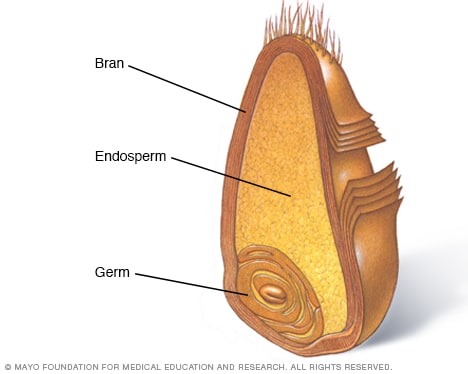
Anatomy of a whole grain
Whole grains include the bran, germ and endosperm. The bran is the outer layer of the seed and contains most of the seed's fiber. The germ is the part of the seed that grows into a new plant. It has lots of vitamins and minerals. The endosperm is the energy source for a seed. It contains mostly starches.
Foods made from grains fall into these categories:
- Whole grains. Whole grains have all parts of the grain. Whole-grain flour is ground from whole grains. Examples of whole-grain food include brown rice, oatmeal and whole-grain breads.
- Refined grains. Refined grains have the germ and bran removed. These grains have a finer texture and a longer food storage life. This process takes out nearly all of the fiber and many other nutrients. Food with refined grains include white rice and most white breads, pastries, cakes, and crackers.
- Enriched grains. The nutrients removed from refined grains may be added back. These refined grains are called enriched grains. For example, when rice is refined, it loses vitamins, minerals and fiber. Enriched white rice has these vitamins and minerals added back. Fiber usually isn't replaced in enriched grains.
- Fortified grains. Foods also may have nutrients added that aren't naturally there. Or food may get a boost in the nutrients that are naturally there. Foods with these extra nutrients are called fortified foods. For example, many breads and breakfast cereals are fortified with folic acid and iron.
The terms "enriched" and "fortified" are often used to mean the same thing. The important point is that whole grain is the most nutritious choice. "Enriched" and "fortified" mean that there is some added benefit.
Benefits of whole-grain foods
The vitamins and minerals in whole grains are important for your overall health. Also, the high fiber content of whole grains may help with:
- Lowering bad cholesterol levels.
- Raising good cholesterol levels.
- Lowering insulin levels.
- Lowering blood pressure.
- Creating a feeling of fullness that can help with weight loss or control.
Studies show high-fiber diets lower the risk of:
- Heart and blood vessel diseases.
- Stroke.
- Type 2 diabetes.
- Cancer of the large intestine and rectum, also called colorectal cancer.
Choosing whole grains
Make at least half the grains in your diet whole grains.
You can find whole-grain versions of rice, bread, cereal, flour and pasta at most grocery stores. Examples of whole grains and whole-grain foods include:
- Barley.
- Bulgur, also called cracked wheat.
- Farro.
- Millet.
- Quinoa.
- Black rice.
- Brown rice.
- Red rice.
- Wild rice.
- Oatmeal.
- Popcorn.
- Whole-wheat flour.
- Whole-grain breakfast cereals.
- Whole-wheat bread, pasta or crackers.
Reading food labels
It's not always easy to know what kind of grain is in a product. For example, bread may look like it's made from whole wheat because it's brown. But the color may be from molasses or some other ingredient.
Ingredient labels can help you choose whole-grain foods. Tips for reading labels include the following:
- Ingredients on a food label are listed from the greatest to least amount.
- The words "whole grain" should be at the beginning of the list of ingredients.
- If there's more than one whole grain, the grains should be near the start of the list.
- If you get all of your grains from whole grains, choose some whole-grain breads or breakfast cereals fortified with folic acid. Folic acid is a form of folate. Folate is very important during a pregnancy.
- If you buy foods with refined grains, look for the words "enriched" and "fortified."
- If you like white bread, try a whole-grain white bread. The flour is made from wheat that has a light-colored bran with a finer texture and milder flavor than regular whole-wheat flour.
How to enjoy more whole grains in your diet
Try these tips to add more whole grains to your meals and snacks:
- Enjoy breakfasts that include whole-grain cereals, such as whole-wheat bran flakes, shredded wheat or oatmeal.
- Substitute whole-wheat toast or whole-grain bagels for plain bagels. Substitute low-fat, whole-grain muffins for pastries.
- Make sandwiches using whole-grain breads or rolls.
- Use whole-wheat tortillas instead of white-flour tortillas.
- Use whole-grain pastas.
- Replace white rice with brown rice, wild rice, bulgur, barley or other grains.
- Use wild rice or barley in soups, stews, casseroles and salads.
- Add whole grains, such as cooked brown rice or whole-grain breadcrumbs, to ground meat or poultry for extra bulk.
- Use rolled oats or crushed whole-wheat bran cereal in recipes instead of dried breadcrumbs.
Eating a variety of whole grains ensures that you get more health-promoting nutrients. A variety also helps make your meals and snacks more interesting.
Dec. 10, 2022
- Whole grains, refined grains, and dietary fiber. American Heart Association. https://www.heart.org/en/healthy-living/healthy-eating/eat-smart/nutrition-basics/whole-grains-refined-grains-and-dietary-fiber. Accessed Nov. 2, 2022.
- Garutti M, et al. The impact of cereal grain composition on the health and disease outcomes. Frontiers in Nutrition. 2022; doi:10.3389/fnut.2022.888974.
- 2020-2025 Dietary Guidelines for Americans. U.S. Department of Health and Human Services and U.S. Department of Agriculture. https://www.dietaryguidelines.gov. Accessed Sept. 8, 2022.
- Grains. MyPlate. U.S. Department of Agriculture. https://www.myplate.gov/eat-healthy/grains. Accessed Nov. 2, 2022.
- Colditz GA. Healthy diet in adults. https://www.uptodate.com/contents/search. Accessed Nov. 2, 2022.
- Black rice. FoodData Central. U.S. Department of Agriculture, Agricultural Research Service. https://fdc.nal.usda.gov. Accessed Nov. 3, 2022.
- Red rice. FoodData Central. U.S. Department of Agriculture, Agricultural Research Service. https://fdc.nal.usda.gov. Accessed Nov. 3, 2022.
- White whole-wheat flour is tasty and nutritious. Academy of Nutrition and Dietetics. https://www.eatright.org/food/nutrition/dietary-guidelines-and-myplate/white-whole-wheat-flour-tasty-and-nutritious. Accessed Nov. 3, 2022.
- How to add whole grains to your diet. Academy of Nutrition and Dietetics. http://www.eatright.org/resource/food/nutrition/dietary-guidelines-and-myplate/choose-whole-grains. Accessed Nov. 4, 2022.
- Hensrud DD, et al. Add 5 habits. In: The Mayo Clinic Diet. 3rd ed. Mayo Clinic; 2023.